Philosophy
The most important ideal in Aubta is "evil" and "good." Aubtay illustrates what happens when you let evil take over, it is something that haunts Aubta. When we look at the word "evil," it seems like a fairytale-esc word.
For the Upoaw, evil is a very real trait and it can infect anyone who worships evil. Their society is split between being individualistic and collectivist. They are very communal when it comes to providing for each other, sharing resources, etc. However, religion is seen as an individualistic thing in their culture. So, with religion being such a big part of life, it does lead to individualistic tendencies. I would say overall they work as more of a collective like a lion pride! Providing for your community and family is really the most valuable thing you can do, thus... extremely honorable. Despite sharing their resources, they have little tolerance as a society for people who refuse to "help," so to speak. Being a basement-dweller is a negative thing in most societies though, so this might not be a shocking answer. Giving a body for your pkoi to live through is very honorable and it's what Upoaw are raised to do. Worshipping evil/the pkoi-oiii is seen as the most dishonorable thing in Aubtay.
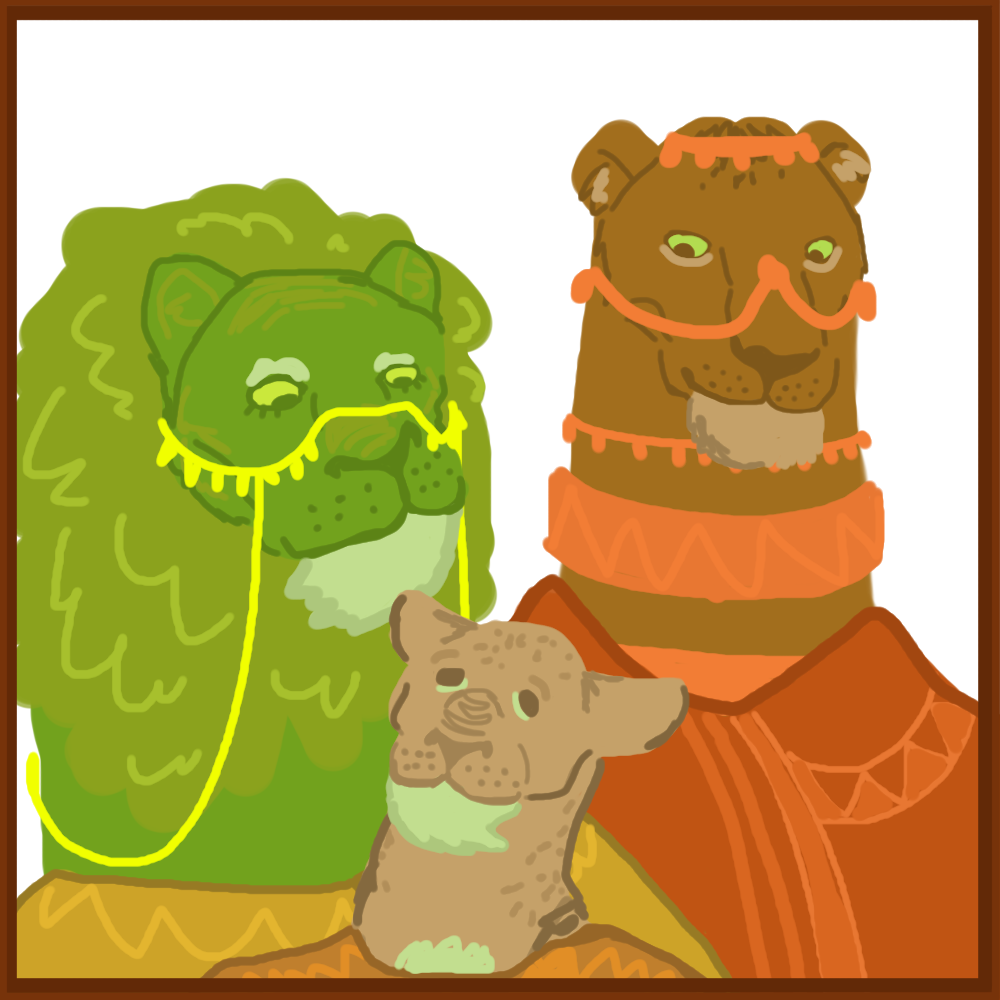
Two Upoaw with their young child.
Upoaw generally accept death as a part of life and teach it to their young early on. There is little fear of death to the point it is seen as absurd or even selfish to fear death. This most likely, in my opinion, comes from the fact they view their life as more of a tool for the gods to live on earth instead of their own independent life. As far as rituals go, it varies from family to family. Most Upoaw will be honored in a way that reflects their life or patron pkoi. However, if it is unknown who their pkoi is (pretty common due to the secrecy of their religion), the pkoi of death (Mhoa) is chosen to represent the funeral. Upoaw love their idols so there are always many paintings, statues, idols, etc at funerals. After death, they believe that nothing goes away, much like the gods/pkoi. They physically died but their presence is still here, looking for ways to interact with the physical realm. They believe everyone does this, not just the gods.
Upoaw's highest aspiration as a peoples is ridding "evil" from the world and bringing back the "good" gods permanently. Quite a lot for mortals to accomplish but I believe in them!
The most taboo thing you can do in Upoaw society is worshipping the pkoi-oiii. If you aren't sure what that is, go to the religion section. I'll take this moment to elaborate on my "Tnguu-young-person-movement" mention in that section. I thought it really only made sense that this younger generation is starting to betray some of the more traditional beliefs, which includes not worshipping the two more... sympathetic-ish "evil" gods? They truly are written to be sympathetic, but the Upoaw as a people are very flighty when it comes to allowing those who have done wrong to get a second chance.
They see animals just like people see animals. Some Upoaw are vegan and some are not, it just depends on the person. The extinction of most mammals in Aubta is a growing concern.
Traditional school isn't really a thing. Trades are either passed down or Upoaw attend "trade-schools." Some people are mentored.

Resting place of an Upoaw who worshiped Ingi.
Population & Politics
There are no known sentient species that aren't Upoaw.
-wou is used to denote royalty. I'll make more honorifics at some other time because I definitely want there to be more. Fun fact, honorifics in my language developed naturally as I made it and I didn't even base it off any particular language, pretty cool! Wou is the word for royal, which is where that came from!
Aubta is neither a matriarchy nor a patriarchy. There are 3 sexes so it just doesn't work the same. There's no "gender" distinction, but class distinction is HUGE.
The government doesn't provide social assistance, your community is supposed to provide for you. You're out of luck if you're without a family or community. Each city and district manages it's healthcare differently.
The government is trusted generally. The government is very hands-off as Aubta is mostly run by independent communities. The government enforces large-scale crimes like murder or worshipping a pkoi-oiii.
They ride water buffalo because it's fucking awesome. So, there is not public transport. You own your own buffaloes or rent them from people with buffaloes.
The Ekgngpoiaw (federal government guards) collect a collective tax from each city monthly.
Education is privitized privatized. Only the rich send their children to school.
There are many domesticated animals for cattle. There are also many crops. You can view these in the biology section. The currency of Aubta is mostly through assets like your crops and cattle.

Political compass.

Explanation of the left and right.
Social
Üpoaw are very community-oriented. They live in pride-like social structures. First there's your family-pride, agiidlng. The leader of your agiidlng is either your grandparents or parents. Occasionally a younger, more fit Üpoaw will take over for their family, but it is rare a young Üpoaw will be a leader of their family.
After your family-pride there is your city-pride, agii, which every Üpoaw plays a role in. You provide for your agiidlng first and foremost, but after you will help your larger community. The leader of the most influential agiidlng will be the leader of the agii as well as keeping their status as the head of their family-pride.
The most influential agii leader of a district can be promoted to the agiiaw, a small council for each district with their own high-courts. One Üpoaw per city in each district. Notable agiiaw are scouted out by the current ruler of Aubta to join their royal council.
Wouefee is the term for the current ruler of Aubta. They are chosen from a vote within their royal council, the Wouikou. Once a Wouefee dies, the council will call a vote and promote their next ruler.
The normal family unit is your parents, siblings, yourself, and possibly grandparents. The entire family and greater community come together to help raise children. As for family structure: There are 3 sexes with Upoaw which means they never really had monogamy to begin with, so they basically just marry whoever and however many people they want. Some Upoaw even marry their pkoi but that's seen as more of a nun-type thing (conjugal chastity).
Typically, Upoaw will marry for love.
The sexes are not treated differently. In my sociology courses, I learned that modern misogyny evolved in a really specific way. Most people would assume it was because of "physical capabilities," but that doesn't make much sense. In the time-period misogyny popped up, broader culture was shifting to an agricultural society. Women were not any less physically capable to tend to their crops, in fact-- women did and still do that. However, what was true about women: They gave birth, keeping them at home while the men went to town and farmed. This is what we believe created modern-day misogyny. All of that to say, all Upoaw sexes have the ability to give birth so there was no "creation of gender discrimination," if that makes sense. However, each sex/gender has different physical attributes which other Upoaw can "prefer," kind of like beauty standards I guess? But it's not really gender-specific.
Lowering your body to the ground on all fours is seen as a gesture or sign of respect. A rude gesture is making hissing noises or sticking your tongue out between your teeth as a "mock hiss".
Stratification

To a certain point there is social mobility. Becoming an agii-yaw, agiiaw-yaw, and wouikou isn't entirely unrealistic if you are a natural born leader and start a family. Ambition is not seen as a good thing so setting that as an intentional goal is looked down upon. You can read more about how those work in the social section of this entire thread. There is an upper class and lower class which is the main form of discrimination in this culture. There is a small middle class of artists but they usually fall into either lower class or higher class, no in between.
The federal government has far more say than any local government when it comes to criminal offenses and setting laws. Most civil cases if not all are done locally or if needed, district-wide.
The lower class obviously faces more discrimination, much like modern-day oppression of the lower class. Smaller individuals also face discrimination.
Fashion

Traditional wear of Upoaw is very simple. They wear silk veils, bridles, garments/robes, hoods, head jewelry, and more.
Traditional wear of the upper class includes lots of pelts and fluffy ones at that. There are very few fluffy livestock in Aubta’s various climates, so the rich only obtain these pelts. Vibrant dyes are also more expensive, especially red. Deep purples are seen as an incredible luxury to the point the rich won’t even flaunt it in public, as it attracts negative attention.
Traditional wear of the lower-class includes regular drapes that are darker or dimmer. They have less jewelry, especially around the neck. Having more neck jewelry is seen as an upper class “habit” because the neck of an Upoaw is very vulnerable. In the older days when wars were more prominent, protecting the neck with many different pieces was a necessity. Now it is more of a decorative thing. It is sometimes seen as tacky for someone of the lower class to have so much jewelry while also wearing dimmer clothing.
Tools
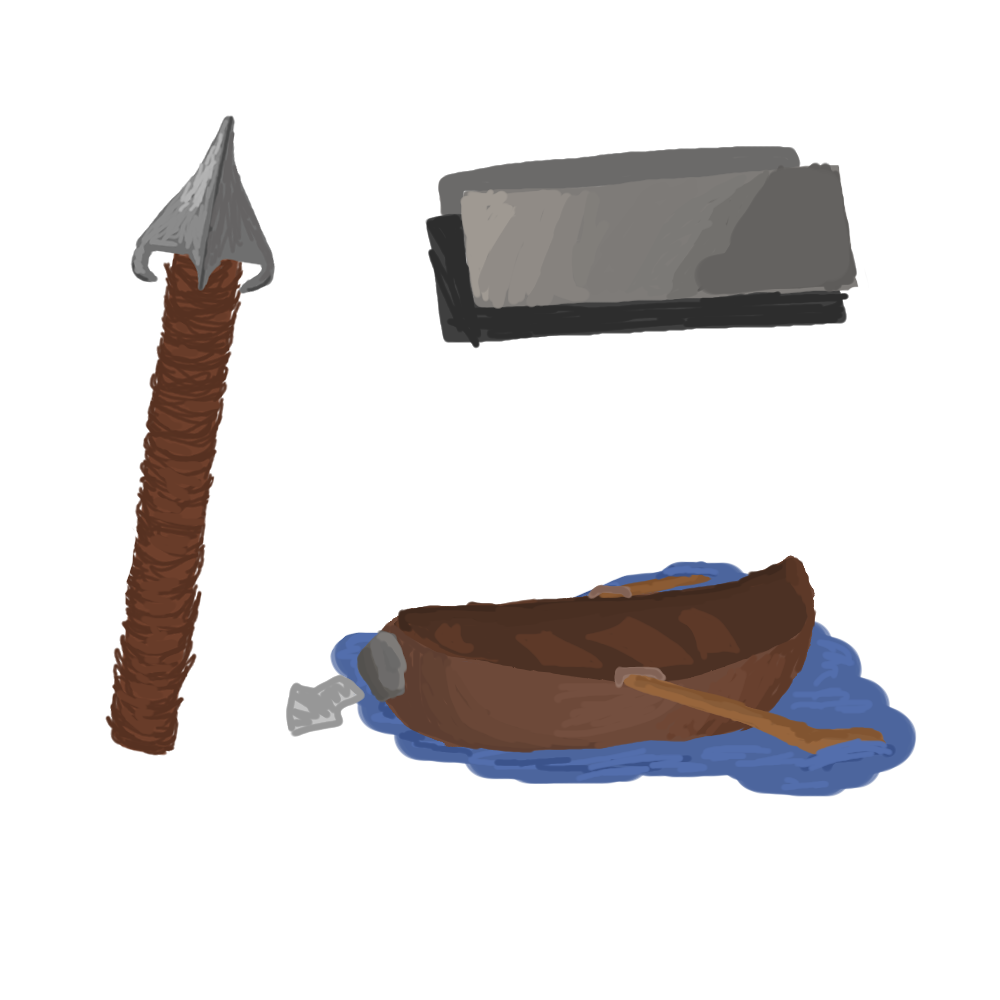
Magnets are very, very common in Aubta. They are used in almost anything-- boats to home storage. Boats (pictued above) are powered by magnets but in an interesting way. There are posts around 20-50 miles from the shoreline with powerful magnets pulling the boats in. They have powerful seperators they use to seperate magnets (pictured above). They have traditional spears with downward hooks to tear flesh when dislodging the spear.